
Pseudodementia: Is it Related to Dementia?
What is Pseudodementia?
Pseudodementia is a popular clinical concept (but not official diagnosis) that includes mental health conditions, that present like organic dementia but are contrastingly reversible. Depression is the most common condition that presents with a clinical picture of pseudodementia. This means depressive pseudodementia looks like dementia but isn’t.
In 1961, psychiatrist Leslie Kiloh observed that some of her patients with cognitive deficit symptoms like memory, attention, and personality disorders, got better when their mood improved. This means that the cognitive decline in these patients was actually due to mental health concerns and not a primary neuro-degenerative disorder of the brain like dementia, as was assumed.
Dementia by itself is known to be a more or less permanent decline in memory, intellect and personality which occurs when specific the cells of the brain (neurons) get irreversibly damaged. Since mental health conditions in Dr Kiloh’s patients were giving rise to a dementia like picture, the term “pseudodementia” (pseudo = false) came about to describe a “false” dementia which in fact was a boon to have because of its potential reversibility of cognitive impairment; unlike the “real” dementias.
How Common Is Pseudodementia?
It is not that uncommon to see patients with pseudodementia in the general population. Depression-associated pseudodementia has been frequently observed in people aged 65 years or older. Which means their memory cells are relatively intact and they can potentially function normally, but they (and their families) tend to believe that they have more serious cognitive impairment like dementia.
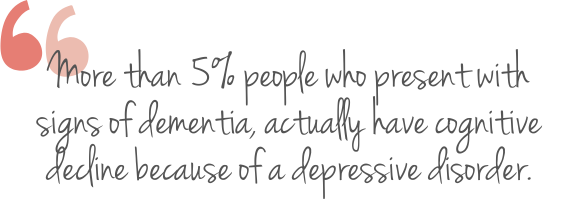
In fact, when such people see neurologists for assessment of cognitive decline, depression alone is the reason for forgetfulness in up to 4.5% of them. Also, when a young individual has such signs, it is even more likely to be pseudodementia. Many seasoned doctors can miss these reversible mood abnormalities because pseudodementia masquerades itself as real dementia so flawlessly.
Depression Associated Pseudodementia: Let’s Understand This
Neurological Signs
- Memory lapses
- Misplacing items
- Forgetting names
- Speech difficulties
- Difficulty Concentrating
- Inability to focus
- Inability to focus
- Slowed mental speed
- Poor information processing
- Problem with planning
- Task disorganization
- Poor activity planning
- Poor decision-making
- Word-Finding Difficulty
- Slowed movements
Slowed movements
- Depressed mood
- Emotional dysregulation
- Fatigue or anergy
- Over or under sleeping
- Low and sad mood
- Unable to enjoy (anhedonia)
- Lack of appetite (anorexia)
- Overeating (hyperphagia)
- Suicidal thoughts or behavior
- Blank facial expression
- Giving up easily
- Fluctuating mood
- Fluctuating memory
- Frustration over symptoms
- Awareness of symptoms
Dementia Causing Depression: Is that Possible?
Can Pseudodementia Progress to Dementia?
How To Identify the Real Problem
The relationship is complicated – depression mimics dementia, depression could be seen in dementia and depression could cause dementia too. Differentiating primary depression from primary dementia is very important. However, this is also quite challenging. The distinction is complicated by the reality that symptoms appear similar; and that depressive pseudodementia is a predictor of subsequent dementia, and dementia itself can make one depressed.
While oftentimes both appear in the same person, sometimes it is possible to discern which emerged first. A notable and crucial difference between the two conditions is that in dementia, people forget, and they forget that they forgot. So, they could become nonchalant about their memory lapses and symptoms. In the pseudodementia of depression however, depressed individuals could seem frustrated about the fact that they cannot remember.
On cognitive tests, they try exceptionally hard and tend to be concerned about their performance. Memory lapse patterns could also differ wherein loss of immediate memories is more pronounced in true dementia whereas recent and distant memories both seem affected in depression associated dementia. Seeking professional consultation, detailed clinical and neurological evaluation and cognitive and emotional testing can be invaluable in discerning the diagnosis and the path of management.
Fact 1: Mimicry
Fact 2: Reversibility
Fact 3: Psychiatric Condition
Fact 4: Quick Onset
Fact5: Family History
Fact 6: The Mood
Role of Cognitive Assessment
How Is Pseudodementia Managed?
Management of pseudodementia focuses on addressing the underlying psychiatric condition, (most commonly depression) which is responsible for the cognitive impairments that resemble dementia. Treatment usually involves a combination of psychotherapy, and medication (antidepressants) where warranted. Psychotherapy focuses on changing negative views of yourself, others, and the world at large.
Cognitive techniques like CBT (Cognitive Behavioral Therapy), REBT (Rational Emotive Behavior Therapy) Therapy), ACT (Acceptance and Commitment Therapy) and Humanistic techniques like EFT (Emotion focused Therapy) and mindfulness, to name a few. All of these work on dysfunctional thoughts, emotions and behaviors that contribute to the development of depression and dementia-like symptoms. It’s very important to differentiate pseudodementia from true dementia, as the cognitive symptoms of pseudodementia can improve with treatment of the underlying depression, whereas dementia typically progresses.
Why You Should Not Ignore This
With medicine and technology continually improving, we are living longer lives. As a population that is increasing in age, the prevalence of cognitive impairment among us will inevitably rise. That is why fast, easy-to-use, and accurate cognitive tests that help diagnose, evaluate, and manage many aspects of cognitive impairment are invaluable in identifying and managing cognitive disturbances.
Dr Shefali Batra believes in a thorough and detailed history with medical psychiatric, psychological and neurological examination alongside neuroscience backed cognitive assessments. We collaborate with Ivory (link to liveivory.com) that offers a 360° cognitive profiling alongside risk factor analysis. Don’t ignore your brain’s functioning. You’ve got only one and it’s priceless.

References
- Brodaty, H., & Connors, M. H. (2020). Pseudodementia, pseudo-pseudodementia, and pseudodepression. Alzheimer’s & dementia (Amsterdam, Netherlands), 12(1), e12027.
- Gonzalez Kelso I, Tadi P. Cognitive Assessment. [Updated 2022 Nov 7]. In: StatPearls. Treasure Island (FL): StatPearls Publishing; 2025 Jan
- Mouta, S., Fonseca Vaz, I., Pires, M., Ramos, S., & Figueiredo, D. (2023). What do we know about pseudodementia? General psychiatry, 36(4), e100939.
Latest Posts
7 Reasons Why You Should Seek Therapy
5 Time Wasters You Need to Overcome
5 Signs you have no work life balance

Work and Life: What is the right balance?